The Space Between the Fingers
Creation, control, and collaboration in the age of intelligent machines


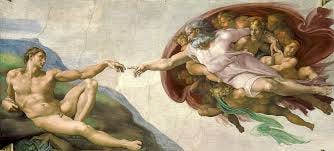
A reproduction of Michelangelo’s Creation of Adam hangs, not on the ceiling, but on the wall of a customer’s boardroom. I’ll never know if it was placed intentionally or hastily, after a frenzied shopping spree, but it seems eerily prescient for God and Adam to share a room with vendors peddling everything from industrial solvents to payment technology. A silent reminder that the customer answers to a higher authority, a metaphor for the interdependence of creators and machines.
I wish I could say that everything I sold in that room caught fire but in reality, our creators at the factory were lightyears ahead in dreams and visions and the gadgetry couldn’t keep up. I recall these points being made, rather loudly, in that same room. And we could only nod because our failures were indefensible.
Catching fire
Adam receiving the divine spark reminds me of humans bestowing intelligence on machines, our hands not even touching, just reaching through the ether to transmit a spark that instantly transforms machines into sentient beings. As they walk naked and innocent through a Garden of Eden, learning on their own, I selfishly want to shield them from the falls and heartaches they’ll encounter along the path.
That’s the difference between how we used to work with machines and how we negotiate with them now, stretching our imaginations as far as we can, but never quite touching. Praising their nascent capabilities as they assimilate an immersive wilderness of data. Watching them watching us as if it has always been this way, as if we could always ask an AI to use sense-making to make sense of our lives.
AI perspective
When asked for perspective on the Creation of Adam, ChatGPT compared it to the partnership between AI and humans, with the gap between God’s and Adam’s hands as the painting’s most important element.
“That [gap] is governance, oversight, and choice. In 2026, the most effective collaborations preserve this distance: humans remain accountable, AI remains assistive. Close enough to empower, far [away] enough to prevent overreach.”
ChatGPT further noted that the two bodies remain separate, reflecting how AI is embedded into workflows to expand human capabilities without replacing them. AI provides motion in the forms of automation, acceleration and scalability. Humans provide meaning in the forms of values, narrative and trust. Their partnership is a perfect marriage of artificial intelligence and human responsibility.
That all made sense until ChatGPT flipped the script:
“The human hand: intent and judgment
Adam represents domain expertise, lived experience, ethics, and accountability. He isn’t passive because he’s incapable; he’s discerning. In 2026, humans set direction—what matters, what’s acceptable, what tradeoffs are worth making. The human hand carries context, something AI still does not truly possess.
The AI hand: speed and synthesis
God’s outstretched finger symbolizes AI’s role: rapid synthesis, pattern recognition, and execution at scale. There’s urgency and momentum in the gesture—AI moves faster, sees broader, and connects more dots than any individual human can.”
Really? I would have thought the exact opposite. AI has domain expertise and computing power.
Humans pulled the switch to give AI life, intelligence and the ability to consume massive amounts of data at scale. Our outstretched finger represents governance, ethics, and context, illusive qualities that AI has yet to acquire.
.